Creativity Networks
Ever feel like your brain is a constant battle between "daydreaming about the weekend" and "actually doing your homework"? Most people think you have to choose one: you’re either a logical, focused person or a "starving artist" lost in the clouds.
New neuroscience proves that the most creative people aren’t just dreamers—they are actually pro-level multitaskers who know how to balance both worlds.
Meet Your Creative "Power Trio"
Forget the old myth that you’re either "left-brained" or "right-brained." In reality, your brain uses three specific networks to get creative work done:
The "Laser" (Executive Attention Network): This is your focus mode. It kicks in when you’re solving a hard math problem or listening to a lecture. It’s located in the front and back of your brain (prefrontal cortex and parietal lobe).
The "Dreamer" (Imagination Network): This is where you go when you’re mind-wandering or imagining the future. It lives deep inside the brain’s temporal and prefrontal regions.
The "Switch" (Salience Network): This is the air traffic controller. It watches everything happening and decides when to "pass the baton" from the Dreamer to the Laser.
The Massive Global Study
A team of scientists recently conducted the biggest study ever on this topic. They looked at 2,433 people from the U.S., China, Austria, Japan, and Canada. Because the study was so diverse, we know these results apply to everyone, regardless of where they are from.
The big discovery? The most creative people have a "Balanced Brain."
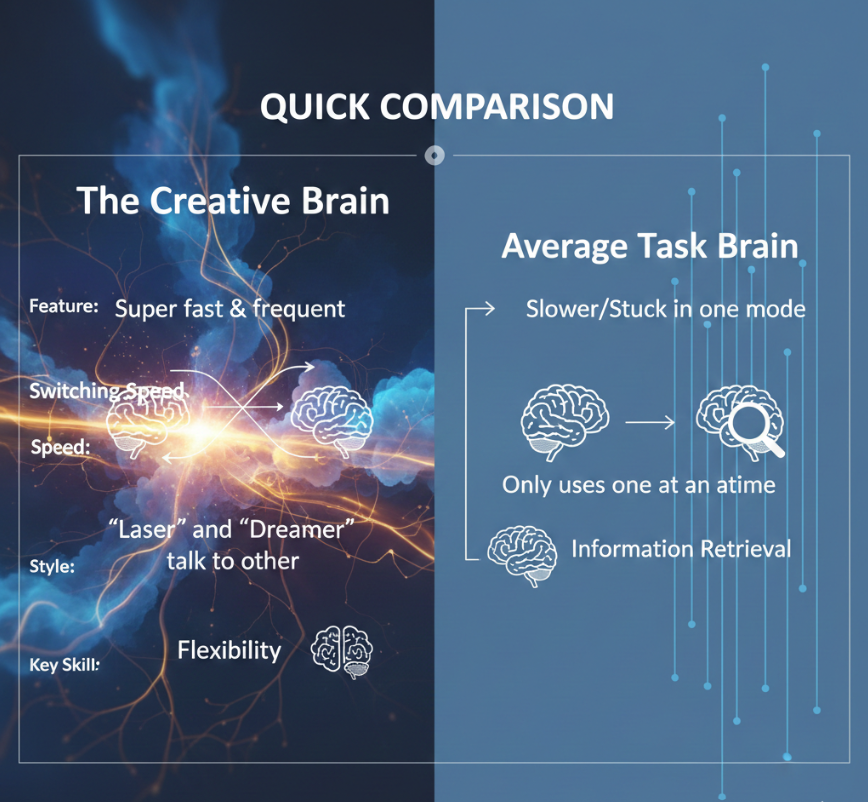
They measured something called Switching Frequency—basically, how fast and smoothly your brain can toggle between "Dreamer" mode and "Laser" mode.
Segregation: When your brain networks work alone.
Integration: When your brain networks work together.
Highly creative people are incredibly flexible. They don’t get stuck in one mode; they switch back and forth efficiently, like a pro gamer moving between different controls.
The "Goldilocks" Zone
The study found that you don't want too much of one thing. The best creative thinkers live in the "Goldilocks Zone" of moderate cooperation.
Intelligence is about pulling facts you already know.
Creativity is about this "neural agility"—the ability to dream up a wild idea and then immediately use your focus to see if that idea actually works.
Fun Fact: This switching ability is specific to creativity. Being "book smart" (high IQ) doesn't necessarily mean your brain is good at this specific type of switching!
Listen to this reflection from the Huberman Lab on building your creative flow:
Mindfulness: It's Not Just About "Boring Focus"
You might have heard that mindfulness or meditation is just about "focusing on your breath" and ignoring everything else. But for a creative person, that’s not the whole story.
Instead of trying to kill your imagination, you can use mindfulness to steer it. We call this Positive Constructive Daydreaming. It’s about being aware of your daydreams so you can use them to solve problems or create something awesome, rather than just getting distracted.
The Bottom Line: You don’t have to be "mad" to be creative. You just need a brain that is fluid enough to dream big and focus hard at the same time. By being mindful of your daydreams, you aren't wasting time—you're actually leveling up your creative potential.