Pursuing EQ

Ever hit "send" on a text when you were fuming, only to stare at your phone two minutes later wishing you could teleport into the void? Or maybe you snapped at your lab partner because you stayed up too late studying, and now things are... awkward.
We’ve all been there. No matter how high your GPA is or how many goals you score on the field, we all struggle with managing our emotions. When we lose our cool, we usually pay the price later—whether it’s a strained friendship or a meeting with the dean.
There’s this old-school idea that you’re supposed to "leave your feelings at the door" when you walk into a classroom or a job. But let’s be real: emotions aren’t like a pair of muddy sneakers you can just kick off. They follow you in. And usually, the people we care about the most—our best friends, our family, or our favorite teachers—are the ones who end up dealing with our bad moods.
Why It Matters
Research shows that "big" negative emotions like stress, frustration, and fear don't just feel bad; they actually sabotage your brain. They mess with your:
Focus and Attention: Hard to study when your brain is on fire.
Memory: Stress literally "blocks" your ability to recall info during a test.
Decision-Making: Anger makes us choose options we’ll regret by sunset.
This is where Emotional Intelligence (EQ) comes in. Think of EQ as the "operating system" for your life. If you can upgrade it, everything else runs smoother. Here are three science-backed ways to boost your EQ right now.
The 2-Minute "Internal Traffic" Check
When we're rude or reactive, it’s usually not because we're "bad people." It’s because we aren't being self-aware. Self-awareness is the ability to notice what’s happening in your head before you act on it.
Try this: Sit down, close your eyes, and check these three things:
Body Scan: Are you hungry? Tired? Is your jaw clenched?
Thought Traffic: If your thoughts were cars on a road, is it a quiet country lane or a 5-lane highway at rush hour?
Emotion Meter: On a scale of 1–10, how intense are you feeling? Is it a "pleasant" intense (excitement) or "unpleasant" (anxiety)?
Why do this? If you realize your "thought traffic" is at a 10, you might want to wait an hour before having that tough conversation with your partner. You’re giving yourself a chance to "clear the road" first.

Hack Your Nervous System (The 4-8 Breath)
If you’re about to give a presentation or walk into a high-stakes tryout, your "fight-or-flight" system is probably screaming. You can actually "hack" your biology using your breath.
The Science: When you inhale, your heart rate speeds up. When you exhale, it slows down.
The Move: Inhale for a count of 4, and exhale for a count of 8.
Do this for two minutes. It signals your parasympathetic nervous system (the "rest and digest" mode) to take over. You’ll go from a panicked 10 to a chilled-out 3 faster than you can finish a TikTok.
Become a "Positive Energizer"
Have you ever noticed that some people leave you feeling totally drained, while others make you feel like you can take on the world? The latter are what psychologists call Positive Energizers.
Being a positive energizer isn't about "toxic positivity" (pretending everything is perfect when it’s not). It’s about micro-moments of upliftment. It takes ten seconds to:
Give a genuine compliment to a classmate.
Share a laugh during a stressful project.
Listen—really listen—without looking at your phone.
Research shows that when you lift others up authentically, you get a hit of dopamine too. It’s a win-win for your mental health and your reputation.
Listen to this reflection from author and speaker Dr. Arthur Brooks on developing metacognition as an EQ skill:
The Mid-Day Reset Plan
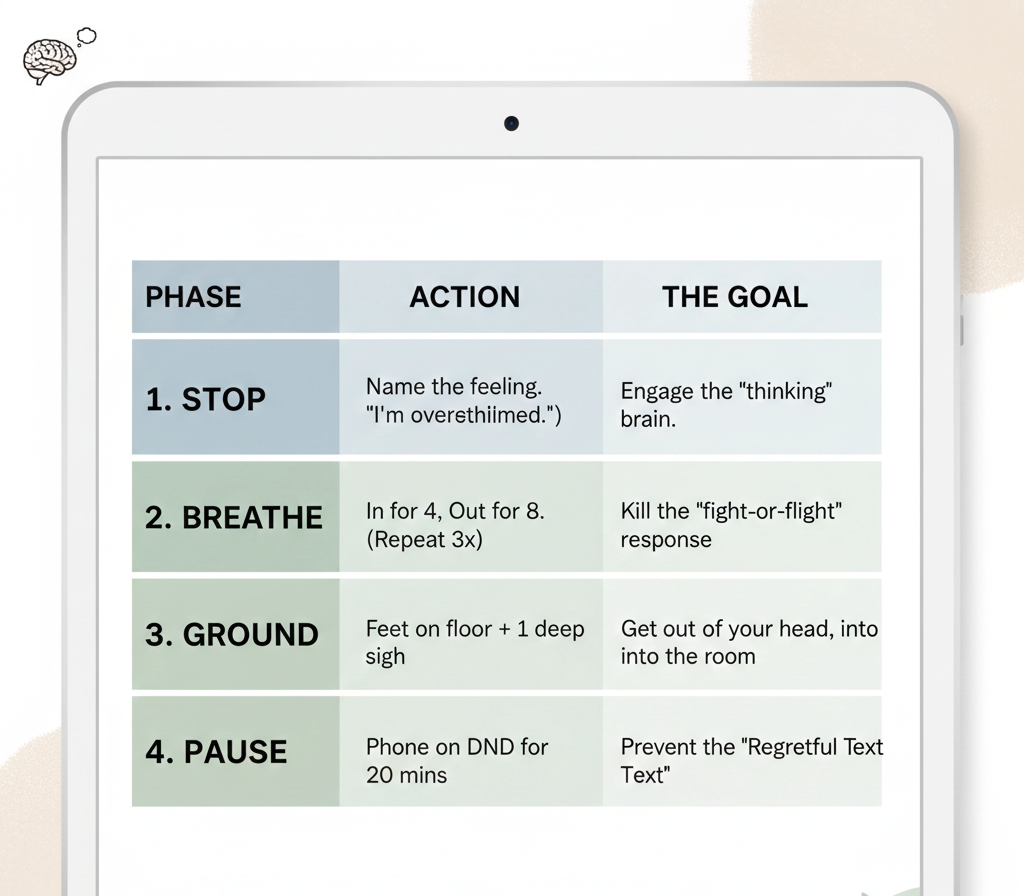
Step 1: The "Name It to Tame It" Scan (30 Seconds) The second you feel overwhelmed, stop and mentally label it.
Ask: "What is this?" (e.g., "I’m not actually mad at my friend; I’m just overwhelmed by this Chem lab.")
The Science: Labeling an emotion moves the activity in your brain from the "panic center" (amygdala) to the "thinking center" (prefrontal cortex).
Step 2: The Physical "Circuit Breaker" (1 Minute) Since you can’t always leave class, use these "invisible" regulators:
The 4-8 Breath: Inhale for 4, exhale for 8. Do this 3 times. Focus entirely on the feeling of the air leaving your lungs.
The Grounding 3-2-1: Silently name 3 things you can see, 2 things you can feel (like your feet on the floor), and 1 thing you can hear. This pulls you out of your head and back into the room.
Step 3: The "Wait" Rule (Social Media/Texting) If the stress involves another person, give yourself a mandatory 20-minute lockout.
Put your phone on 'Do Not Disturb' or toss it in your bag.
The Rule: Do not hit send until your "Internal Traffic" (from the blog post) has dropped at least two levels.
Step 4: The Micro-Uplift (The Rebound) To fully reset your mood, do one tiny "pro-social" thing.
Text a "good luck" to a friend.
Thank a teacher on the way out.
Hold the door for someone.
The Result: This forces your brain to switch from "defense mode" (stress) to "connection mode" (EQ).
Before you say or do anything while stressed, ask yourself:"Will my '10:00 PM Self'—laying in bed tonight—be glad I did this, or will they be cringing?"
If the answer is "cringing," stick to Step 2 and keep breathing.
The Bottom Line
We spend years learning math and history, but we rarely get a class on "How to Be a Human." Cultivating EQ—self-awareness, self-regulation, and connection—doesn't just make you "nicer." It makes you more effective, less stressed, and way more likely to succeed in whatever you do next.