Beyond the Classroom: Cultivating Belonging

Walk down any high school hallway between periods. You will see hundreds of students standing shoulder-to-shoulder, yet many of them are completely alone. Eyes glued to glowing screens, headphones firmly in place, they navigate an environment that is densely populated yet deeply isolating.
We often assume that because teens are constantly connected online, they are more connected than ever. The research says otherwise.
Global studies show that adolescent loneliness nearly doubled between 2012 and 2018 across dozens of countries—a sharp rise that started long before recent world disruptions and continues to impact our schools today. Today's high schoolers aren't just experiencing typical teenage angst; they are facing a structural crisis of social alienation.
To address this, high school Social-Emotional Learning (SEL) cannot remain a transactional exercise in checking boxes or filling out worksheets. It must become a blueprint for authentic belonging.
Drawing on the research and relational framework of former U.S. Surgeon General Dr. Vivek Murthy in his landmark book, Together: The Healing Power of Human Connection in a Sometimes Lonely World, educators, parents, and young people have a powerful roadmap to transform our schools from places of quiet isolation into genuine communities of connection.
"Loneliness is an innate human response, a signal built into our evolutionary biology that tells us when a vital need isn't being met. Just as hunger tells us we need food and thirst tells us we need water, loneliness warns us that we need connection."
— Dr. Vivek Murthy (former U.S. Surgeon General), author of Together
The Hidden Mechanics of Teen Alienation
To solve the loneliness epidemic in our schools, we first need to understand what chronic social isolation actually does to a teenager’s brain.
Threat Loop: When Loneliness Becomes Self-Defeating
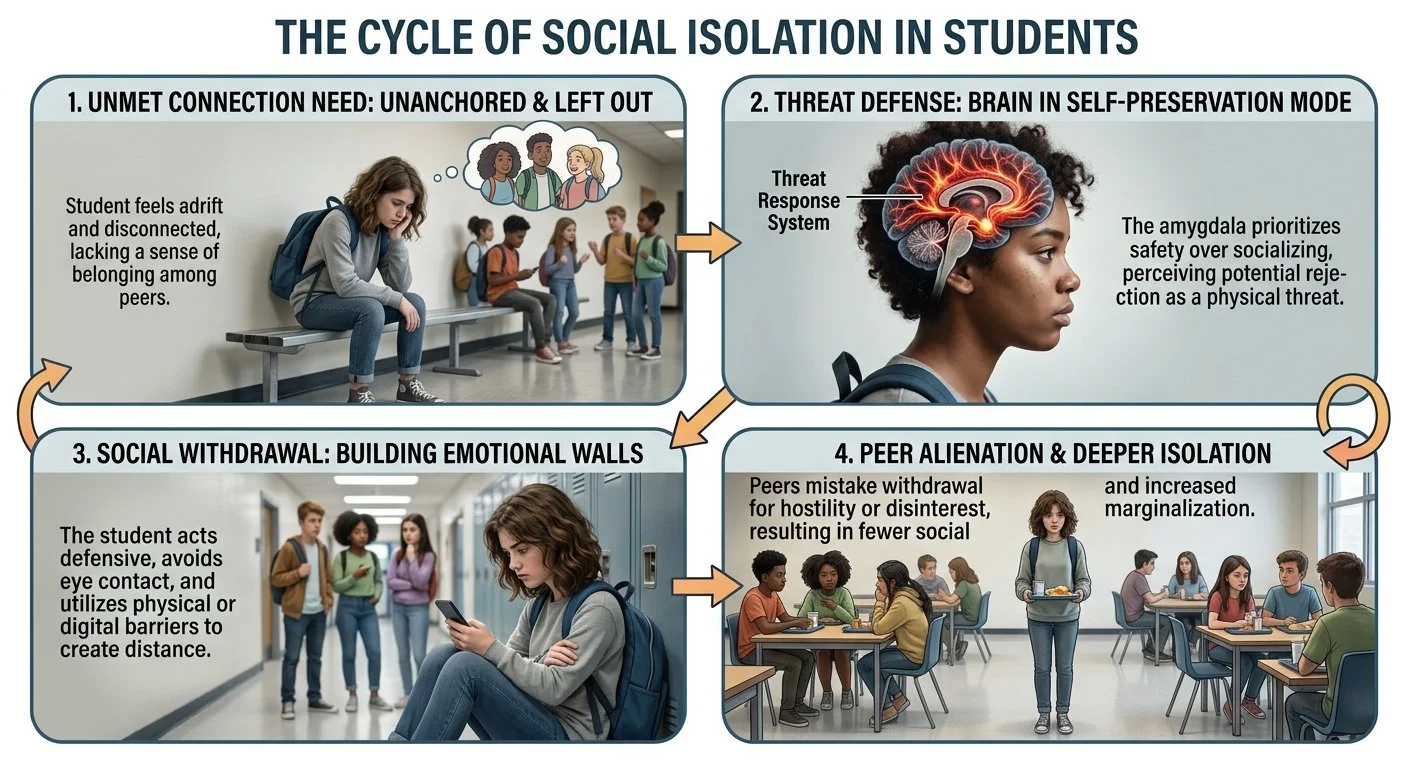
Loneliness isn't just a sad feeling; it’s a biological stress response. When a student feels chronically disconnected, their brain enters a hyper-vigilant threat mode.
Within a school setting, a lonely student's self-protective instincts take over. They begin misinterpreting neutral social cues—a classmate who didn't look up, a quiet group table, a delayed text response—as intentional rejection.
This triggers a self-fulfilling loop:

Three Circles of Connection
In Together, Dr. Murthy explains that human connection isn't one-size-fits-all. We require three distinct circles of relationship to feel complete:
Intimate Connection: Having at least one close friend or confidant who truly knows, accepts, and supports you.
Relational Connection: Belonging to a group of regular, high-quality friends and peers you see daily.
Collective Connection: Feeling part of a shared community bound by common values, purpose, or identity.
A student can be a star athlete embedded in school spirit (Collective) while secretly lacking a single person they can confide in (Intimate). Another student might have one great friend (Intimate) but feel entirely detached from the broader school culture (Collective). Effective high school SEL must intentionally support all three levels.
3 Strategic Pillars: Bringing Together into the Classroom
Translating research into daily school life requires actionable strategies. Here are three core pillars that schools can adopt to foster deep-rooted connection:
Pillar 1: Reclaim Presence over Distraction
Students live in a world of fractured attention. When they interact while simultaneously checking notifications or wearing earbuds, they lose out on the non-verbal cues—micro-expressions, vocal tone shifts, eye contact—that signal safety and empathy.
Reclaim presence: Designate advisory blocks or specific classroom routines as "Off-Device, In-Person" windows. Teach explicit active listening skills, such as mirroring statements and asking open-ended, curious questions, rather than jumping straight to advice or evaluation.
Classroom Practice: The 2-Minute Reset
Before starting group work, ask students to put screens face down, make eye contact with their partner, and share a 60-second answer to a low-stakes prompt (e.g., "What is something small that made you smile this week?"). This simple routine breaks the hyper-vigilance loop and establishes presence before academic tasks begin.
Pillar 2: Activate the Healing Power of Service
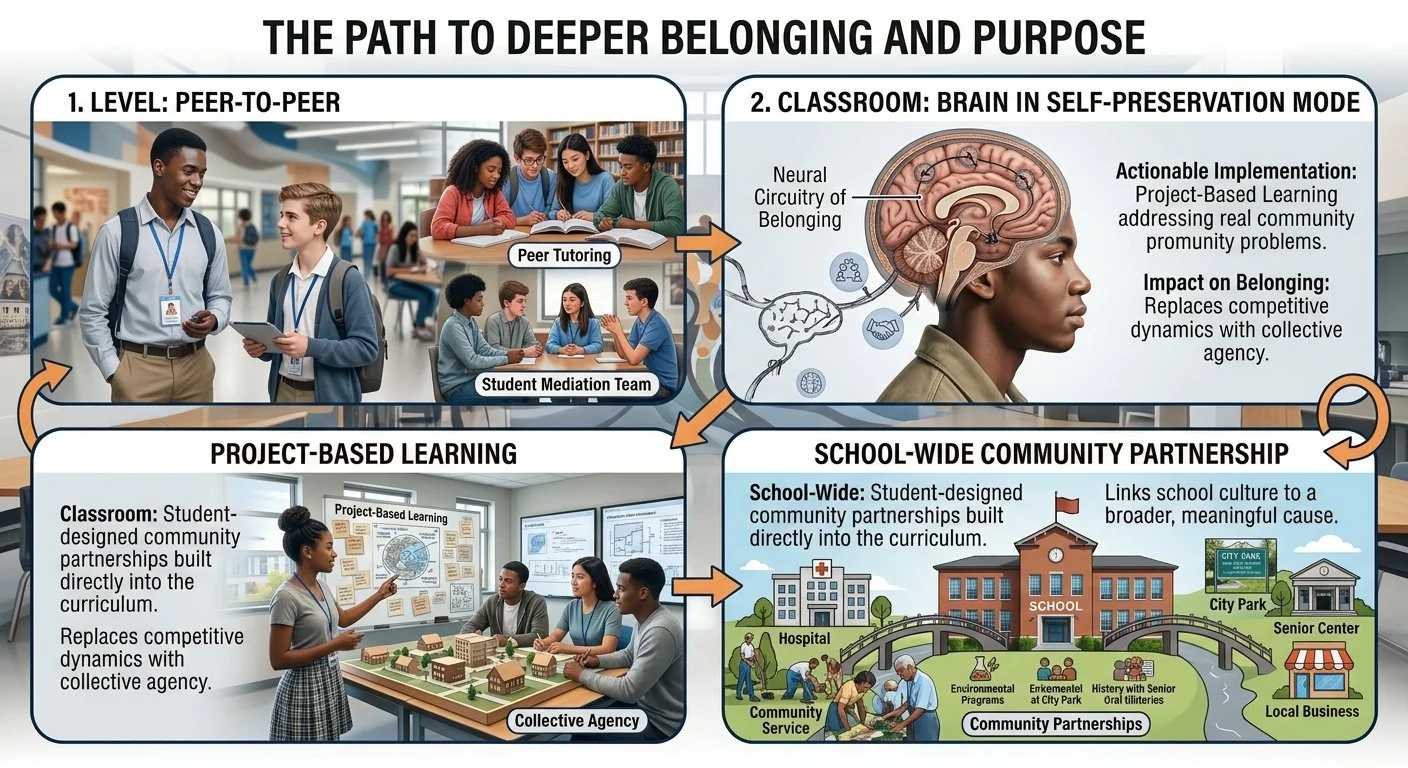
One of Dr. Murthy's most profound insights is that service is a direct antidote to loneliness. When students help someone else, their focus shifts away from self-conscious worry ("Do people like me?") to outward impact ("I have value to offer").
Traditional View: Receive Connection → Feel Validated→ Build Confidence
Murthy's Service Model: Give Help & Support → Recognize Own Worth → Form Mutual Connection
Pillar 3: Ground Belonging in Self-Compassion
True belonging is not the same as fitting in. Fitting in requires changing who you are to be accepted; belonging requires being who you are and knowing you are accepted anyway.
Teaching self-compassion helps students navigate the inevitable social stumbles of high school without spiraling into self-loathing or withdrawal.
In Practice: Help students distinguish between isolation (painful disconnection) and restorative solitude (quiet, intentional time to recharge). Teach teens that feeling awkward or out-of-place is a universal human experience, not a personal flaw.
Redesigning the High School Day for Belonging
To make connection systemic, schools must build relational infrastructure directly into their weekly routines.
Transform Advisory into "Space Gatherings"
In Together, Murthy highlights "Space Gatherings"—structured, safe circles where people come together to speak openly without fear of judgment. High schools can adapt this by shifting advisory periods away from logistical announcements and toward structured relational circles.
Prompts like "What is a burden you're carrying this week that people might not notice?" or "Describe a time you felt invisible" create immediate opportunities for genuine vulnerability.
Weave Connection into Core Subjects
SEL should not be isolated to a single 20-minute advisory block. Academic subjects offer natural opportunities for relational growth:
English & Literature: Analyze character choices through the lens of social safety, isolation, and empathy.
STEM: Highlight the collaborative, human side of scientific breakthroughs, demonstrating that real progress happens in community.
Arts & Physical Education: Capitalize on synchronized movement, music, and group creation, which naturally release endorphins and bond groups together.
Tailored Action Steps for Every Role
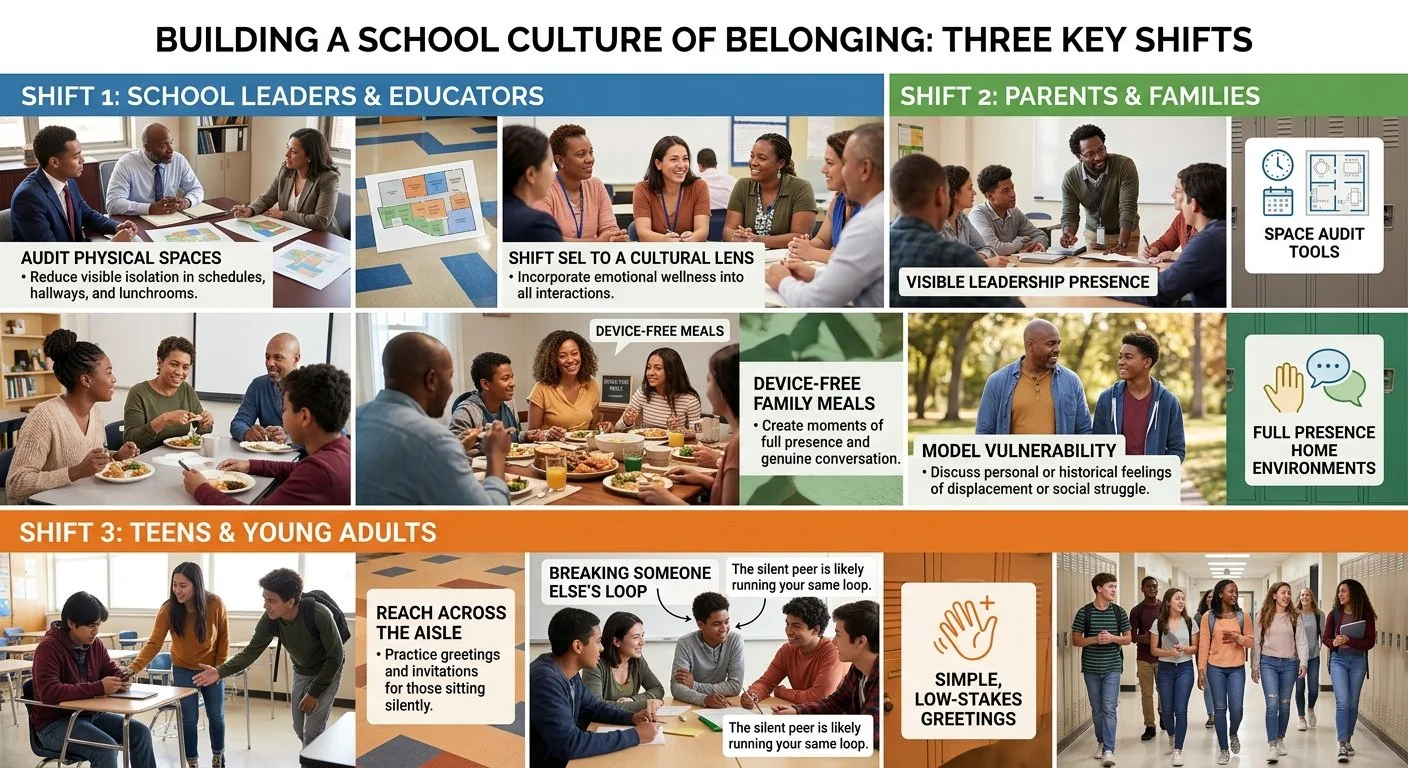
Healing adolescent loneliness isn't just up to teachers; it requires a village working across every sphere of a student's life.
A Path Forward: A Culture Shift
Ending the adolescent loneliness crisis will not happen through quick fixes or assemblies. It requires an intentional commitment from educators, administrators, families, and students to build a school culture grounded in relational care.
When we teach students how to show up with full presence, serve one another, and embrace self-compassion, we do far more than improve their academic performance—we give them the tools to build a lifetime of connection.